Welcome
Welcome to my Professional Issues in Early Childhood Education portfolio. This site highlights my experiences, beliefs, and professional growth as I prepare to be an early childhood educator.
Inside, you will find my statement of purpose, professional responsibilities, lesson plans, reflections, artifacts aligned with the NAEYC standards, and documentation that shows my commitment to providing safe, nurturing, and developmentally appropriate care for young children and their families.
Name: Julia Panella
Program: Early Childhood Education
Course: Professional Issues in Early Childhood Education
Degree Goal: Associate in Applied Science – Early Childhood Education
College: Oakland Community College
Expected Graduation: December 2026
Email: juliapanella35@gmail.com
Phone: 248-269-3612
Current Role: Nanny and Early Childhood Educator
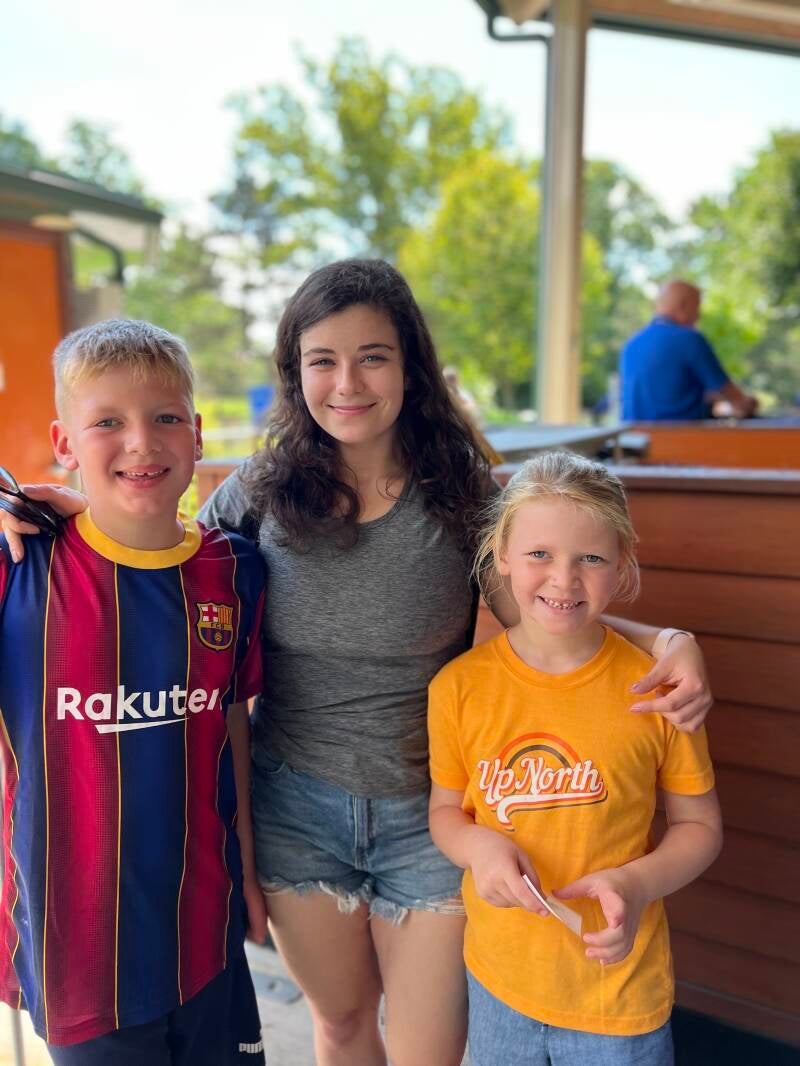
This is a picture of my nanny kids and I from 2022!

Portfolio Statement of Purpose
This portfolio was created as part of my Professional Issues in Early Childhood Education course. Its purpose is to show who I am as an emerging professional in the field of early childhood education. Through my work as a nanny, daycare teacher, and latchkey teacher, I have seen how high-quality early childhood experiences shape children’s confidence, curiosity, and social-emotional skills.
In this portfolio, I document my understanding of professional responsibilities such as mandated reporting, confidentiality, and ethical practice. I include lesson plans, reflections, and artifacts that connect to the NAEYC standards, as well as recommendations from people who have seen my work with children.
My goal is to continue growing as an educator who is caring, reflective, and responsive. This portfolio is both evidence of my current abilities and a starting point for continued professional development.
Child Abuse & Neglect – Mandated Reporter Statement
As an early childhood professional, I understand that I am a mandated reporter of suspected child abuse and neglect. This means I am legally and ethically required to take action if I have reasonable cause to believe that a child is being harmed or is at risk of harm.
I recognize the four main types of abuse and neglect: physical abuse, sexual abuse, emotional abuse, and physical or emotional neglect. My role is not to investigate, but to observe, document, and report concerns.
If I suspect abuse or neglect, I will:
- Carefully document what I see and hear, including dates, times, and objective observations.
- Follow my program’s policies and procedures, including immediately informing my supervisor or director.
- Make a report to Child Protective Services within the required time frame.
- Treat the child and family with respect, maintaining confidentiality while fulfilling my legal duty.
I understand that mandated reporting protects children and supports families in getting needed help.


Statement of Commitment
I am committed to being a caring, trustworthy, and professional early childhood educator. I will:
- Put children’s safety and well-being first in every decision I make.
- Respect each child as a unique individual, with their own strengths, culture, and learning style.
- Partner with families, honoring them as their child’s first and most important teachers.
- Use developmentally appropriate, play-based, and inclusive practices.
- Maintain professional boundaries and communicate respectfully with families, colleagues, and children.
- Continue learning through coursework, professional development, and reflection.
- Uphold confidentiality and ethical standards, following program policies and the NAEYC Code of Ethical Conduct.
Signed: Julia Panella Date: 10-20-2025
Ethical Code Satement
My work is guided by the NAEYC Code of Ethical Conduct. I have ethical responsibilities to children, families, colleagues, and the community. In my daily practice, I use this ethical code to guide decisions, especially in complex situations. When I am unsure, I seek supervision, consult the code, and reflect on how to best protect children while respecting families and colleagues.
Michigan DHS Clearance / Eligibility Letter
I have received my Michigan DHS Central Registry Check, confirming that I am not identified as a perpetrator on the central registry as of August 28, 2025. Below is a link to this letter, which can be accessed by pasting url in a new search bar.
file:///Users/juliapanella/Desktop/CRC%20letter%20Panella%20J%20(2).pdf
Resume
My resume summarizes my education, work history in early childhood settings, and key skills such as reliability, patience, and strong communication.
file:///Users/juliapanella/Desktop/!JPanella-updated%20resume!.pdf
Letters of Recommendation
Amanda Lamoreaux, RN, BSN, MSN
Amanda has known me personally for many years and has observed my interactions with her young child. She describes me as compassionate, dependable, and professional, with a natural ability to connect with children while maintaining structure and care.
file:///Users/juliapanella/Desktop/julia%20letter%20of%20recommendation-amanda.pdf
Asalya Akins
Asalya and I worked together at Olive Branch Daycare. She highlights my welcoming attitude toward coworkers and families, my ability to stay calm and helpful in a busy classroom, and my initiative in stepping in to support children without being asked.
file:///Users/juliapanella/Desktop/Recommendation%20Letter-%20Julia.pdf
Tiffany Demos
Tiffany Demos, who has worked closely with me in an early childhood setting, highlights my reliability, strong work ethic, and the positive, calming presence I bring into the classroom. She describes how I consistently show patience, compassion, and attentiveness when working with young children. Tiffany emphasizes my ability to build trusting relationships with both children and coworkers, noting that I am someone who takes initiative, communicates well, and always maintains a professional attitude.
file:///Users/juliapanella/Downloads/Julia%20Panella%20LOR%20103025.pdf
My Reasons for Becoming a Teacher & Philosophy of Teaching
I have always been drawn to working with children. From my earliest experiences babysitting to my work in daycare and as a nanny, I have felt a strong sense of purpose when I am caring for and teaching young children. Over the years, I have seen the impact that patient, loving, and consistent adults can have on a child’s confidence and joy.
I believe that early childhood is a powerful time in a person’s life. Children are forming their sense of self, learning how to express their emotions, and discovering how the world works. I want to create classrooms where children feel safe, seen, and valued.
My philosophy of teaching is grounded in the idea that children learn best through play, relationships, and meaningful experiences. Learning should be hands-on and play-based, the classroom should be inclusive and respectful of diversity, and guidance should be respectful and focused on teaching skills rather than punishing behavior. Families are essential partners, and I want to communicate openly and invite them into the learning process.
My long-term goal is to be the kind of teacher children remember as someone who believed in them and helped them feel capable and loved.
Group Lesson Plans
As part of this course, I created 15 group time lesson plans designed to support children’s social-emotional, language, and cognitive development through play-based, engaging activities.
file:///Users/juliapanella/Desktop/Group%20Time%20Lesson%20Plans%20&%20Reflection.pdf
NAEYC Standards & Artifacts
Standard 1 – Promoting Child Development and Learning
I understand that young children develop in multiple domains—physical, social, emotional, language, and cognitive—and that these areas are connected. I use my knowledge of child development to create safe, nurturing, and developmentally appropriate environments and experiences.
Example Artifact:
Activity Title: Feelings Faces Group Time
Age Group: Mixed ages (2.5–5 years)
Objective:
Children will learn to recognize and express basic emotions such as happy, sad, angry, and surprised.
Materials:
-
Emotion cards or pictures
-
Small mirror
-
Optional: puppet
Procedure:
-
Begin group time by showing one emotion card (ex, “happy”).
-
Ask children what the face looks like and invite them to copy it.
-
Pass around a small mirror so children can look at their own expressions.
-
Introduce 2–3 more emotions the same way.
-
End by asking children when they have felt one of these emotions.
Open-Ended Questions:
-
“How does this face look?”
-
“When do you feel happy/sad/angry?”
-
“What helps you feel better when you’re upset?”
Modifications:
-
Younger children: focus on two emotions and simple labeling.
-
Older children: discuss coping strategies and feelings in different situations.
Assessment:
Observe whether children can label or imitate the emotions and participate in the discussion.
Rationale:
This lesson aligns with NAEYC Standard 1 because it supports children’s development across the social-emotional domain, which is a key component of early learning. By helping children recognize and express basic emotions, the activity promotes self-awareness, emotional regulation, and the ability to interact positively with others. These skills are essential for building healthy relationships and participating successfully in a group setting. The use of emotion cards, mirrors, and modeling makes the activity developmentally appropriate for a mixed-age group. Younger children can practice imitating facial expressions, while older children can build a deeper understanding by discussing when they have experienced certain feelings. This shows my ability to plan an experience that meets children where they are developmentally, while also supporting growth.
Standard 2 – Building Family and Community Relationships
I believe that families are children’s first teachers and most important partners. I work to build trusting, respectful relationships with families and to communicate regularly and honestly with them.
Example Artifact: Newsletter
Hello Families,
This week in our classroom, we are learning about feelings and emotions. The children have been exploring different facial expressions, practicing how to name feelings, and talking about things that help us feel better when we are upset. These activities support children’s social-emotional development and help them learn to communicate their needs.
At home, you can continue this learning by asking your child questions such as:
-
“How are you feeling today?”
-
“Can you show me your happy/silly/surprised face?”
-
“What helps you feel calm when you’re upset?”
Thank you for your continued support and partnership. Please reach out if you have any questions or would like ideas for helping your child with emotions at home.
Warmly,
Ms. Julia
Rationale:
This family note demonstrates NAEYC Standard 2 because it shows my commitment to building strong, respectful, and supportive relationships with families. By sharing what we are learning in the classroom and offering simple ideas that families can use at home, I am helping to create a consistent connection between school and family life. This supports children’s development by ensuring that the adults in their lives work together and communicate openly. The note is written in a warm and accessible tone, making families feel welcomed and informed. It encourages partnership by inviting families to participate in their child’s learning and by offering continued support if they have questions. This reflects my understanding that families are children’s first and most important teachers and that strong communication is essential to high-quality early childhood education.
Standard 3 – Observing, Documenting & Assessing
I would use observation and documentation to understand each child’s strengths, interests, and needs, and to plan activities and communicate with families.
Example Artifact: Anecdotal Notes
Child: M.S.
Age: 4 years
Date: 10/12/2025
Time: 10:30–10:33 AM
Observer: Julia Panella
Running Record:
10:30 – M.S. sits at the table and picks up a marker. She draws a circle and says, “That’s me.”
10:31 – She adds two dots for eyes and a line for a mouth. “I’m happy today,” she says.
10:32 – She draws another circle, adds short lines for arms, and says, “This is my baby sister.”
10:33 – She looks at the teacher and says, “She cries a lot, but I still love her.”
Interpretation:
M.S. is demonstrating representational drawing skills and emotional understanding. She is using language to describe her family relationships and feelings, which shows social-emotional development and symbolic thinking.
Rationale:
This anecdotal observation demonstrates NAEYC Standard 3 because it shows my ability to observe children objectively, document what I see, and use that information to understand their development. By recording only the child’s actions and words, I am practicing accurate and unbiased observation, which is essential for assessing progress and planning appropriate learning experiences.
The interpretation and next steps sections reflect my understanding of how observation helps guide curriculum and support each child’s individual needs. By identifying the skills the child is showing and thinking about what to offer next, I am using assessment to inform instruction in a developmentally appropriate way. This aligns with Standard 3’s expectation that educators use observation and documentation to support children’s learning and communicate effectively with families.
Standard 4 – Using Developmentally Effective Approaches
I use teaching strategies that are developmentally appropriate, culturally responsive, and based on positive relationships with children. I support learning through play, small-group work, open-ended questions, and positive guidance.
Example Artifact: Play-based activity plan with teacher reflection.
Activity Title: Color Sorting Sensory Bins
Age Group: Mixed ages (2.5–5 years)
Objective:
Children will explore colors, practice sorting, and develop fine-motor and language skills through hands-on play.
Materials:
-
3–4 small bins
-
Pom-poms, blocks, or objects in different colors
-
Scoops, tongs, or cups (optional)
Procedure:
-
Place one color in each bin.
-
Invite children to explore freely and sort the objects by color.
-
Encourage conversation about colors, textures, and choices.
-
Allow older children to use tongs or sort by additional categories (size, shape).
-
Gather together to look at sorted bins and briefly share what everyone noticed.
Teacher Prompts:
-
“What colors do you see?”
-
“How did you decide where to put that one?”
-
“What else can we sort by?”
Modifications:
-
Younger children: Allow open exploration with simple color naming.
-
Older children: Add sorting challenges (patterns, counting, comparing).
Rationale:
This activity and reflection demonstrate NAEYC Standard 4 because they show how I use developmentally appropriate, play-based strategies to support young children’s learning. By offering an open-ended color sorting sensory activity, I am creating an experience that allows children to explore materials, make choices, and learn through hands-on play—an essential part of effective practice in early childhood education.
The plan shows that I adapt my teaching to meet the needs of a mixed-age group by providing support for younger learners and extending the activity for older children. This reflects my understanding that children develop at different rates and benefit from individualized approaches. The teacher reflection highlights my ability to observe children’s cues, adjust my guidance in the moment, and use play as both a teaching method and a way to assess learning.
Overall, this artifact demonstrates my ability to use responsive, intentional, play-based teaching strategies that promote exploration, inquiry, and positive interactions—key expectations of NAEYC Standard 4.
Standard 5 – Using Content Knowledge to Build Meaningful Curriculum
I use my understanding of content areas—such as language and literacy, math, science, social studies, the arts, and physical development—to plan an integrated, meaningful curriculum.
Example Artifact: Integrated lesson plan that combines literacy, math, and science.
Activity Title: “Counting Seeds: Apples Inside and Out”
Age Group: Mixed ages (2.5–5 years)
Objective:
Children will explore apples using literacy (story + vocabulary), math (counting + comparing), and science (observation + prediction).
Materials:
-
Real apples (different colors if possible)
-
Plastic knives (teacher only), cutting board
-
Small bowls
-
Chart paper
-
Book: "Ten Apples Up On Top" or another apple-themed story
-
Paper & crayons
Procedure:
1. Literacy (Book + Vocabulary)
-
Begin group time by reading an apple-themed book.
-
Introduce vocabulary: skin, peel, seeds, core, stem, juicy, inside/outside.
-
Ask children to predict what they think is inside an apple.
2. Science (Observation + Prediction)
-
Show the whole apple and ask: “What do you notice?”
-
Cut the apple in half in front of the group.
-
Children observe and share what they see: shape of the core, seeds, color, smell.
3. Math (Counting + Comparing)
-
Place the seeds in bowls so children can count them.
-
Compare amounts (more/less/same).
-
If using different apples, compare sizes and seed numbers.
4. Wrap-Up (Drawing + Language)
-
Children draw an apple showing inside and outside, and teachers write their words if needed.
-
Share drawings during group time.
Open-Ended Questions:
-
“What do you think is inside the apple?”
-
“How many seeds do you see?”
-
“Which apple has more seeds?”
-
“How are the apples the same? How are they different?”
-
“How does the apple smell or feel?”
Modifications:
-
Younger children: count seeds up to 3, simple describing (“red,” “round”).
-
Older children: compare multiple apples, make simple charts, draw details.
Assessment:
Observe:
-
Ability to describe objects
-
Counting and comparing
-
Participation in predictions
-
Use of vocabulary
-
Engagement during book reading
Rationale:
This integrated lesson demonstrates NAEYC Standard 5 because it shows my ability to use content knowledge from multiple subject areas—literacy, math, and science—to create a meaningful and engaging learning experience for young children. By combining a story, hands-on apple exploration, and counting activities, I am creating a lesson that is connected, developmentally appropriate, and relevant to children’s natural curiosity.
The activity helps children build vocabulary through a read-aloud, practice math skills by counting and comparing seeds, and develop scientific thinking by observing, predicting, and exploring the inside of an apple. Integrating these content areas supports deeper understanding and allows children to learn in ways that feel natural and enjoyable.
This lesson also reflects my ability to plan a curriculum that meets the needs of a mixed-age group. Younger children can participate through simple observations and counting, while older children can engage in more complex comparisons and use descriptive language. This flexibility shows my understanding of how to use content knowledge to create experiences that support learning across developmental levels.
Standard 6 – Becoming a Professional
I see myself as a member of the early childhood profession. I follow ethical guidelines, continue my education, seek feedback, and advocate for high-quality care and education for all children.
Example Artifacts: PQA
file:///Users/juliapanella/Desktop/Preschool%20PQA%20pdf.pdf
Rationale:
A PQA (Program Quality Assessment) demonstrates NAEYC Standard 6 because it shows my ability to engage in professional practice, self-reflection, and continuous improvement—key components of being an early childhood professional. Standard 6 focuses on professionalism, ethical behavior, and growing in the field, and a PQA directly supports these expectations.
By completing or participating in a PQA, I am showing that I can:
-
Evaluate the quality of learning environments, teacher-child interactions, and program practices.
-
Reflect on strengths and areas for growth, which helps me improve my teaching.
-
Use professional tools that are widely recognized in the early childhood field.
-
Make decisions based on best practices and standards, not just personal preference.
-
Advocate for high-quality learning environments that support children and families.
A PQA also requires using objective observations, documentation, and knowledge of early childhood standards—all professional behaviors that align with NAEYC’s expectations.
Therefore, including a PQA as an artifact demonstrates that I understand what high-quality early childhood education looks like and that I am committed to evaluating and improving my own practice, which is the core of Standard 6.
Create Your Own Website With Webador